Why American Baby Formula is Uniquely Toxic
Let's look at this product:
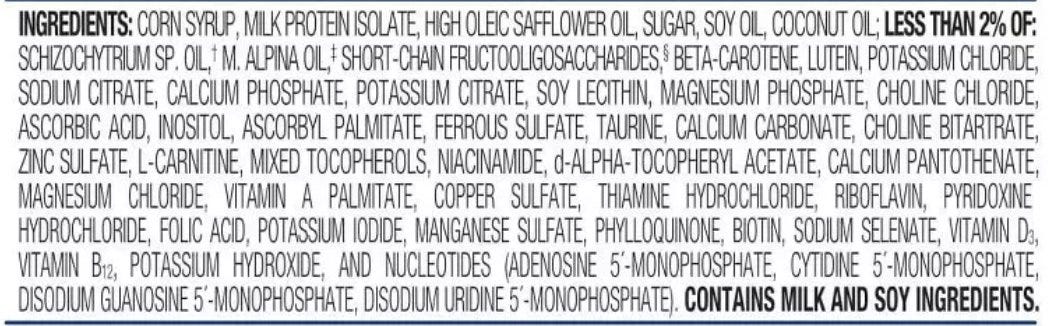
What you're looking at is the ingredient list for the best selling baby formula in America.
Yes, you read that correctly. The primary ingredient in the most popular baby formula is corn syrup. Sugar, soy oil, and safflower oil also are among the top 5 ingredients.
Infant formula in the US is so bad it's hard to believe. Not just the ingredients (though those are about the worst I could imagine), but also the history of formula companies, and the fact that the FDA practically mandates the above ingredients are included in formula.
Let's dive in to what I think may be among the worst products harming Americans health: infant formula.
A dark history
The baby formula industry has an insanely dark history that's hard to believe. In the 1970s, Nestle aggressively marketed formula to mothers in developing nations by basically scaring them. They literally had sales reps dress up as nurses, and approach new moms to convince them that formula was superior to breast milk. They would then provide free samples just long enough for mothers' natural milk to dry up, forcing dependency on their product. They convinced mothers that formula was more "Western" and "modern" than breastfeeding.
The results were catastrophic. Mothers who couldn't afford enough formula would dilute it to make it last longer, leading to malnutrition. Many lacked clean water to mix with the formula, causing life-threatening diarrhea and infections. By some estimates, literally millions of infants died as a result of these practices.
I don't know what to call this other than evil. Big Food has reps push a high-margin (but nutritionally bereft) product to millions of new mothers, millions of babies die, Nestle keeps moving on.
Rigged growth charts
The formula companies use other tricks to spur demand for their candy formula products. For example: you know the growth charts your pediatrician uses to tell if your baby is underweight or overweight? For decades, they were created by the formula industry!
As Dr. Robert Mendelsohn, a renowned pediatrician and early critic of the industry, discovered, these charts were deliberately manipulated to list above-average weights for each age group. This meant many perfectly healthy breastfed babies would appear "underweight" compared to formula-fed babies (who tend to be heavier).
Worried parents would hear: "your baby is in the 25th percentile for weight. We might need to supplement with formula." What they weren't told was that breastfed babies naturally grow at different rates than formula-fed ones, and being in the 25th percentile is completely normal.
Regulation mandates seed oils
Perhaps the craziest aspect of this whole situation is that American regulations actually mandate unhealthy ingredients in formula. The Infant Formula Act of 1980, passed in response to nutritionally inadequate formulas making babies sick, incorporated outdated nutritional science from the 1970s.
These regulations require that at least 2.7% of formula calories come from linoleic acid—the problematic fat found in seed oils. This makes it literally illegal to sell formula in America without seed oils, despite mounting evidence that these oils contribute to obesity and metabolic dysfunction.
I've spoken with several physicians who believe this requirement is a root cause of America's childhood obesity epidemic. Seed oils impair mitochondrial metabolism and promote fat storage from infancy. A systematic review of the research shows that formula-fed babies experience "excessive and rapid weight gain" compared to breastfed infants.
Though the Secretary of Health and Human Services has the authority to update these guidelines as science evolves, they haven't done so in decades. Which makes RFK's recent push for Operation Stork Speed wildly important and exciting!
Breast milk is irreplaceable
Breast milk is a marvel of evolutionary design, and the more I learn about it the wilder it is. It contains antibodies that protect infants from disease, stem cells that help with development, and even contains proteins and fats that infants cannot digest in order to attract beneficial bacteria that can help colonize the baby's gut better!!
No formula can replicate this complexity. Breast milk contains over 1,000 proteins, whereas formula typically contains around 30. The composition of breast milk even changes throughout a single feeding and as the baby grows. Breast milk is even diurnal—morning milk contains compounds that help the baby wake up, while milk at nighttime contains melatonin to aid in sleeping.
Studies consistently show that breastfed babies have higher IQs, lower obesity rates, fewer allergies, and better immune function than formula-fed babies. For mothers, breastfeeding reduces the risk of breast cancer, ovarian cancer, and postpartum depression. For those who struggle with breastfeeding, there are milk banks and companies like It's My Leche doing great (but admittedly weird!) work.
Today's formula is poisoning infants, and pretending that corn syrup and soybean oil is a reasonable substitute for the most complex and health-promoting product that humans can consume. Fixing our formula (and encouraging breastfeeding) should be an urgent public policy.